CSaR Monthly Magazine of CUTM
After receiving the news, the principal and other faculty member’s arrived at the location. As it was a suicide case, family members of the deceased and cops gathered to investigate. This tragedy left a lasting impression on both the school and the children. Written by […]
FictionAfter receiving the news, the principal and other faculty member’s arrived at the location. As it was a suicide case, family members of the deceased and cops gathered to investigate. This tragedy left a lasting impression on both the school and the children.
Written by Adyasha Parida, Harshita Singh, Khumbar Debbarma, B.FSc, 8th Sem
‘Hostel life’ a fresh chapter in everybody’s life, where we hope to write pages of joy and happiness but occasionally we face trails that leave us with bad memories and restless nights for a life time. With age, I’ve discovered that there are places that you don’t want to step foot in, but circumstances lead you there.
One such is an incident I’m about to share of Aravalli hostel. It was an early summer evening where I raced back to the hostel with my friend after our classes were over. We parted ways since we had different destination. As I was about to walk through my dorm’s main entrance, I heard a cry it was my friend’s I realized, without a moment of hesitation I dashed towards it. Getting closer to her hostel, the weeping and cries got louder, it almost sounded like a frantic yearning to help someone. I realized something was gravely wrong. As I stood at the entrance of the room, I saw an image that has stayed with me to this day: a rope hanging from the fan, my friend struggling to lift someone’s leg, but the face was obscured by a blanket, I grasped the scenario; I was scared of the sight in front of me and shouted in distress without a second thought. The house mistress and others rushed after hearing my cry, only to reveal a scenario that no one could have predicted: the house mistress collapsed at the sight and was ready to tumble off the steps when others ran to hold her. My friend and I, as well as other students, were taken out of the hostel, wailing and sobbing.
After receiving the news, the principal and other faculty member’s arrived at the location. As it was a suicide case, family members of the deceased and cops gathered to investigate. This tragedy left a lasting impression on both the school and the children.
The regular visits of cops persisted in the midst of our on-going final examinations, leaving the entire campus lifeless as if someone had hit the pause button in our lives, and when the frequent visits eventually ceased a few days later, we assumed our everyday lives could return to normal. Students started heading home the day after final examinations concluded with the announcement of summer vacation, but a few of us chose to leave the next day just to spend another night together because we had a two-month summer vacation. We were
joyfully packing our luggage and making vacation arrangements without knowing what was about to happen.
As the night approached and drops of rain started to hit the window, we realised it was time to call it a night. We placed our luggage in one corner of the room and headed for the bed. I remember being woken up by a peculiar sound – heavy yet shrill. I looked around and nothing seemed out of place, my drowsiness got the better of me and my eyelids started feeling heavy. I rested my head on the pillow only to hear that sound once again, but this time it was clearer, from what I could make out it was the sound of something heavy being dragged.
The sound was getting louder by the second; I dared not raise my head for God knows what that could be. Fear crept into my senses and made me numb. I wanted to call out and ask if it was just someone’s silly night prank, but my numbness did not even allow my voice to come out. I shut my eyes and prayed, prayed with all my heart, prayed for the sun to shine and end this night.
The loud screech came to a stop near my bed. Now what? Is this my end? Will this be how my chapter will end? It was quite, so quite almost like the sound of death, I laid still, slowed down my breathing, hoping to make minimal movements on my part. I stayed like that, crying in my prayers, wishing for the night to end. I don’t know how many hours passed by like that it became a mission to survive.
‘Wake up’ a familiar voice called, and my eyes opened in routine it was my friend. The sun rays hit my eyes, it was only then I breathed an air of relief. The terror from last night still fresh to my bones, but maybe I just had a nightmare, yes that’s possible. I got off my bed and bent down to grab my slippers; my eyes fell on my luggage that I placed yesterday night in the corner of the room to be under my bed. How did it reach there?
As a result of situations like these, people are quick to pass judgement. For some, it becomes a joke, but for others who have experienced it, it leaves a scar.
There’s more to this than meets the eye.
That day my mother was ill and she was bedridden when we were hunting the prowler. According to the localities this prowler was attacking only after midnight women and girl childs were only attacked. The victims were shredded from……(pages burned)………outside ……(pages burned)………. I and my […]
FictionThat day my mother was ill and she was bedridden when we were hunting the prowler. According to the localities this prowler was attacking only after midnight women and girl childs were only attacked. The victims were shredded from……(pages burned)………outside ……(pages burned)………. I and my fellow hunters were there waiting for this prowler to attack after midnight.
Written by Sidharth Ranjan Sarangi, B.Tech (Ag) 3rd Year
DAIRY OF ADAITYA
Ghosts , Demons , Monsters, The super naturals These are the different names of them, throughout my life I hunted some and some of them hunted me and killed my beloved , these were “atrupta atma” or the lost souls who were not able to go to heaven or hell and some of them were made by the deities these were more powerful than the lost souls. I ………(pages burned)pattajoshi……..pages burned
“Rajan”
“Rajan stop reading those old books, study engineering books not those old useless books and that dairy that is burned, so throw them out” Rajan’s mother said , Rajan replied “I will ,just let me read this one you never let me read these when I was child and now you were telling these are useless and burned, let me tell you these are the legacy of our ancestors and I don’t want to hear throw that or these next time ok.” “ok” mother replied and told “ sleep early don’t stay up all night its already 10:45, good night” Rajan replied “good night maa”
Rajan Starts reading
1868 MONTH OF ASWINA ,AMAWASYA
That day my mother was ill and she was bedridden when we were hunting the prowler. According to the localities this prowler was attacking only after midnight women and girl childs were only attacked. The victims were shredded from……(pages burned)………outside ……(pages burned)………. I and my fellow hunters were there waiting for this prowler to attack after midnight. Then suddenly a pale purple light with heavy thundering sound at light speed summoned throughout nowhere and was directed towards my village. We mounted our horses and chased the light, then suddenly at a house it disappeared to be precise it teleported inside the house we went inside and witnessed the demon transforming into shiny small particles and went inside of her body through her breath we woke her up but she was half possessed by the demon and she was conscious while the demon was eating her , her shouts were unhearable it was like she was in pain and someone blocked her mouth from shouting, as a result her throat to burst and made the terrible sound , we all witnessed that terrible view. After second the pale light reappeared and started running in the direction of my home ,my fellow hunters were there and unware of the demon escaping . I started following that demon alone the demon did the same with my mother but I didn’t let her breath by forcefully inhaling those shiny particles but it was effectless the demon possessed my mother and killed. When he was killing her from inside I chose to save the world than saving my world so I stabbed the holy weapon gifted by the old gods in my mother’s heart. Then the demon was trapped in her body so I did burn her body in the traditional way without any tantric activity and after that there was no prowler attacks , I realized I did the right thing.
Rajan stops reading
“oh its midnight
Ok its time to sleep” Rajan blabbered and slept.
The next moring his mother was dead, doctors said that it was a total organ failure and some of her organs were bursted. After the 11th day Rajan returned and again starts reading the dairy.
1876 MONTH OF BAISAKHA ,DWITIYA
these were summer days and I was using the holy weapon as a fan because it could control all the five elements and I was alone after hunting the “bahoroopi” or mimics my fellow hunters were fallen into their trap but I killed them all by the grace of the holy one. Mimics greatest weakness is they will not attend the natures call, they will not fear any animal in rage or you cant scare them by sound, so when their guard is down you can kill them by stabbing a knife into their eye………pages burned…(Rajan stops reading)
The next day
Rajan goes to college, attends class”attend all roll call” mam shouted
Mam-“ RUDRA RAJAN DESHPANDE” RAJAN- “PRESENT MAM”
MAM – “WHY ABSENT FROM LAST 12 DAYS” RAJAN-“ MY MOTHER EXPIRED” MAM-“ OH SORRY”
CLASS ENDS
and at last goes to his girlfriend to talk
Rajan said “ I missed you priya” , priya replied “yeah ,miss you,miss you”
Rajan asked” your mood off “ priya replied “lets go to the old temple “
Rajan asked “ that’s a broken temple what we are going to do there”
Priya replied “ we will repair that”
Rajan said “ok” knewing that her mood was off and accepted. While going to temple it was a little cloudy and little thundering were their and suddenly a bolt of thunder blasted a tree in front of them and Rajan got scared and ducked but priya was standing straight. Rajan remembered the dairy and thought she was a mimic then SUDDENLY “oh these are stories” he said to himself. There was a herd of buffalo grazing in the near field and suddenly another bolt of zeus and every buffalo ran towards the couple. They were near the temple and Rajan ran towards it. While running his legs were tangled by some vines and he fell. Then he saw priya standing in the middile of the running herd and every buffalo avoiding her, then he realized her careless talk , not fearing the thunder and buffaloes avoiding hers was not coincident she is a mimic, he confirmed, then took a half blunt wood and stabbed it in her eyes. She turned into ashes then he ran to her home for telling her parents that their daughter was missing but when he reached there was police. He asked the police what happened and they replied they found a dead body In a nearby well and its spine and skull were not there by dna test it was confirmed that it was their daughter.
Rajan realized these are not stories the further he was reading more of his beloved were dying then he stopped reading. Later that day when he was brushing in front of the mirror and a rail of dark smoke went behind him he turned back and was scared “oh why these things are happening to me” said to himself. A deep low pitched voice loudly said “mere human, start reading” he covered his ears in fear but the same sentences echoed for a minute. “oh at last it stopped “ (starts brushing) looks into the mirror there were two bright red glowing eyes were behind him he was terrified and flew away from there.
Now he starts reading the last page ,there was an incomplete mantra, he starts chanting the mantra in hope he will get rid of these all mishaps.
Rajan “BHO MAHAT KSA DRAHA, TABA NIDRASHYU DRAHASCHA HANTA ETE SUSKA MANABAAHA( it means oh great demon rise and kill humans )” Rajan unknowingly the meaning of the mantra he chanted and after the third time a terrible 10 armed figure with 10 bright red glowing eye was in front of him. Now he trembled with fear and the tall figure stated-
“Fool,you freed me I will let you live, look in front of you human, your great grandfather is the reason you are here, he theft my scripting, my writings(roaring) he trapped me in 2 connected traps,(laughs) he was intelligent but he wasn’t a God, after I released from The holy chains of Brahma(name of the first trap) I killed him instantly shredded him into thousand pieces and it triggered the second trap which I was unaware of and that was my soul will be inside that book forever, until someone reads half of my writings which was copied by that wicked human”
The demon flies into the sky breaking the sealing of the house.
Rajan kneels and starts reading the dairys last pages in hope to kill the mighty demon.
1893 MONTH OF MARGASIRA,PURNIMA
Shira-khanda an evil tantric, intelligent as Shukracharya, was consumed by dark magic and today he is going to make a powerful demon from the remains of a god and a daitya. He has made dummy and hid parts of the god remains inside the dummy. I went there to the ……….pages burned…….
Rajan “stupid dairy it is useless” threw the dairy into nearby burning fire.
Went to sleep, the next moring
“oh at last someone is not dead ” goes to watch the tv. Turns on the tv “I have to know about the 8th pay scale I must watch news” switchs to a news channel.
Headlines “Massacre throughout the city by a demon, thousands of people are dead , impossible to count because all their body parts are shreded, roads are turned to blood rivers, now even the military is involved to stop the colossus, the colossus was last spotted near the hotsprings”
Rajan “what have I done! I have to do something, there are more books in the shelf there should be a remedy” searches intensely but lost hope of finding any clue then he finds a letter written by his great grandfather to his younger brother, he instantly checks the address and now he knows the name of his great grand father his name was ROUDRADEV PATTAJOSHI(a title given by the kings of that era). Rajan mumbles”because of you not only me but also the whole world is in danger” again starts searching then he found a secret tiny hidden chamber there was a crystal in it. On the crystal there was a riddle written it stated
| “A demon in the pit who eats dead meat blood of their heir is the ink which the demon drinks the demon will change their fate and they will reincarnate”
|
And on the backside of it was written madhuban. Rajan knew about the great madhuban , it was a dense jungle situated nearby. He cracked the riddle little bit and was aware that this pit where the demon resides is in madhuban. Now he decided to go on a expedition to search this demon in hope to get rid of all the mishaps. He took the crystal went to nearby jungle.
In the jungle he started searching for this pit. Even after 4 hours there was no sign of this pit.he was tired and sat near a tree watching the setting sun. Suddenly the crystal started shining as the sun has half dipped in the mountains in front of him. Rajan threw the crystal as he was scared, when the crystal touched the ground the glowing footsteps started appearing in the earth Rajan picked up the crystal and followed the footsteps. He reached at the pit.
There was no sign of the demon. Then he remembered the riddile “A demon in the pit who eats dead meat” that means I require some dead meat to attract this demon, fourtunately there was a dead body of a deer hunted by an unknown animal, Rajan pulled that deers dead body near to the pit. Suddenly a demon appeared from inside the pit and started devouring the deer. Rajan in thoughts “everything is happening according to the riddle but still there is some part which I am missing in the last part there was-heir’s blood is the ink which the demon drinks and will change the fate they will reincarnate” (Rajan thoughts) “yeah got it the person who will reincarnate his name should be written with the ink which is their heir’s blood, that means root of all these things “the great great grandfather” can be reincarnated , I should write his name with my blood in front of the demon” Rajan did as he said and the demon opened a portal connecting to purgatory where the souls with a incomplete wish resides , and from the portal Roudradev comes out, and zap kills the reincarnating demon ,with some bright blue cosmic energy slash by just moving his hands like sword, so that no one ever again will be able to reincarnate anyone.
Rajan”why did you killed it” Roudradev replied (a deep Omniacceptable godlike voice) ”it was necessary child, we have to kill Adaitya as soon as possible, other wise it will be a great danger”Rajan said(while returning home)”old man where is your holy weapon and how did you killed that demon with your bare hands, who is that 10 armed demon , how you are going you kill him, who is shira-khanda, which demon killed my mother, who is Adaitya say say something old man” Roudradev replied”calm down child I didn’t have any weapon I myself am the weapon, our ancestors has given us the powers from generation to generation, and I killed the reincarnation demon by bare hands because when the demon reincarnates any human, his abilities will be multiplied infinite times. Shira-Khanda is the creator of all this mess he created a demon from the remains of an unknown old god and blood of “amaparakta” ” “wait who is Amaparakta” Rajan asked. Dev replied ”the other demonic threat of which we are unaware” Rajan said “we reached home, let us watch what that 10 foot demon has done and where it was last spotted”(turns on tv) on news-” A colossal hand of almost 3 km has erupted in the northern Himalayas” Rajan asked ”old man is this Amapa rakta”the old man saw the figure in the tv and replied “yes and we need to reach there as soon as possible Adaitya must have to be there to complete the rituals to wake Amaparakta up, I must stop him” Rajan said “just answer my questions” Roudradev replied “I will child but not now on the way I will”
They started their journey from Bhubaneswar to Bhuntar by plane then from bhuntar they took a train , from bhuntar the nouthern Himalayan regions were 221 km far. While on the train Rajan asked Roudradev “how my mother died” the old man replied “I don’t know ” Rajan said “whenever I read a story a demon or a ghost came to real life and killed someone” holy man replied “whose story you have read before the death of your mother” Rajan replies “prowler’s” the old man asked “how your mother died” Rajan replied “by total organ failure and her heart burst according to the doctors” the old man said “yes it was the prowler , prowler’s victims were hurt from the inside outside remains untouched” Rajan said “so it was the burned part ”so then tell me who is Adaitya” Rajan asked, roudradev replied “shadow of shira-khanda, made from the remains of an old god and the son of a daitya- Adaitya(not daitya), the 10 foot demon you freed, shira-khanda found some remains by touching it he knew it was the remains of an old god and Amaparakta is the last daitya, Amaparakta gave his blood to shira-khanda and in order to complete the ritual he has to concentrate in the Himalayas shirakhanda told him , before the completion of ritual I binded the remains of the gods by the chains of Brahma without shira-khanda’s awareness, I killed shirakhanda but unfortunately the ritual was complete by then the adaitya rise but was trapped but he was writing something on the soil I controlled him by the chains and started coping those writings before I finish Adaitya ,but Adaitya has the body parts of a God so he was able to free himself from the chains of Brahma , and killed me the rest you know ” .
Train stops announcer of the station-“Himalayas in 5 minutes” , “we are near” dev replied “I can sense them but Amaparakta is still in sleep” Rajan asked “how” Dev replied “he must have been frozen while concentrating and Adaitya’s work was to tell him that the ritual is complete, but he was trapped in that book, he must have been weak since he was trapped in the book for a long time” Rajan said “he is not weak, he have killed uncountable since yesterday” roudradev suddenly ”brace yourself, child ” Rajan asked “what”, the train goes out of track. Rajan survived came outside and saw limbs of hundreds dismembered all over the place Rajan shouted” old man where are you” dev replied “behind you” Rajan asked “what happened” dev replied “he threw a boulder at us” Rajan asked “who” from the skies Adaitya roars and says “me”.
The demon falls from the sky giving the two a shockwave, adaitya roars “embrace the true power of Adaitya humans, bare your fangs and show me what you have prepared for me” roudradev replied”we are prepared and now you will know how your ancestors were defeted”, Adaitya jumps towards Roudradev but in a blink his arms were riped off by roudradev’s airblades roudradev’s movements were as fast as light, the demon replied “so you are a God now” Dev replied “no you are weak , I can see your fathers hand erupting from the top of that mountain I will kill you both at once, just stay in front of me” they fought, adaitya roared “ ready for a rain of demons”, Adaitya opened a portal and demons from the past which roudradev allredy hunted came , Dev pulled out two swords from air and moved the swords in a gyroscopic way that no demon was able to escape that it looked like a sphere crushing the demons, Rajan shouted old man ”Adaityas eyes were burning like hot rods” without any hesitation roudradev ripped his head off now the demon was headless instantly pulled out a spear from air and threw towards the demon that made a hole in the chest of the demon, Rodradevs spear was so powerful that it drilled the himalays and hit the heart of amaparakta causing both daitya part and god part bleeding at a time causing both turn into ashes.
Rajan was speechless and asked “old man what just happend”
Roudradev replied ”adaitya was jealous, he was neither a daitya nor an ashura and that burned in his eyes, He thought he was weak which he wasn’t ”
“tell me how you killed them both” Rajan asked
Roudradev -“ Adaitya , half god half daitya , the god part was jealous by seeing such power of a daitya when it felt jelous it starts burning, it was first on his birth but i didn’t recognized that but now there is no threat. Roudradev’s body starts disappearing, Rajan asked “what is happening to you old man” he replied ”it’s the end of all child stay safe , child”.
A moment of glory and euphoria filled the heart of every Odia in February, 2014, when Odia language became the sixth language in the country and the first from the Indo-Aryan Linguistics group to receive classical status after the union cabinet approved it on the […]
Culture History Non-FictionA moment of glory and euphoria filled the heart of every Odia in February, 2014, when Odia language became the sixth language in the country and the first from the Indo-Aryan Linguistics group to receive classical status after the union cabinet approved it on the premise of the language possess high antiquity of its early texts/recorded history over a period of 1,500-2,000 years, a body of ancient literature/texts which is considered a valuable heritage by generations of speakers and a literary tradition that is original and not borrowed from another speech community
Written by Subhendu Kumar Mishra, Assistant Professor, CUTM
The state of Odisha not only endowed with the most precious natural resources but has a rich culture and tradition. The State depicts amazing convergence of art and beauty through its ancient rock inscriptions, temples, pagodas, music, dance and crafts. The language of the land is known as Odia and is spoken by close to 50 million inhabitants.
A moment of glory and euphoria filled the heart of every Odia in February, 2014, when Odia language became the sixth language in the country and the first from the Indo-Aryan Linguistics group to receive classical status after the union cabinet approved it on the premise of the language possess high antiquity of its early texts/recorded history over a period of 1,500-2,000 years, a body of ancient literature/texts which is considered a valuable heritage by generations of speakers and a literary tradition that is original and not borrowed from another speech community. The demand of the state which was pending since 2005 finally became reality. Nevertheless, the path to this distinction was not without challenges and many renowned linguists and scholars like John Beames, G.A. Grierson, L.S.S. O’Malley, Suniti Kumar Chatterjee, S.N. Rajaguru, K.B. Tripathy, John Boulton, and D.P. Pattanayak have time and again argued in favour of the antiquity of the language. Dr. Debi Prasanna Pattanayak who headed the committee to prepare a report to be submitted to the cabinet strengthen the claim of Odisha is praiseworthy. The scholars claim that the Udra Bibhasha (Language) later known as Odia language is derived from Ardhamagadhi Prakrit and was found to be mentioned in Bharatmuni’s ‘Natyashastra’ in 4th Century BC. Moreover, the rock inscription during King Ashoka in 1st Century BC and King Kharbela in 3rd Century BC and many Buddhist and Jain writings during 8th and 12th Century were testimonial to the Odia language as a distinct one.

Dr. G.N. Das in his article “History of Oriya language” has brought the story of Odia language upto 1500 A.D and the story of the development of prose and poetry in Odia language about which information is provided by palm leaf inscriptions and copper plate grants and rock inscriptions. The epigraphists, historians and archeologists have faound evidences of the earliest settlers of Odisha were primitive hill tribes. At the rock shelters of Bikramkhol, Ushakothi, Ullafgad, Gudahandi, Jogimatha (Odisha) humans lived throughout the Upper Paleolithic age, revealing cave paintings dating to 7000 BC. More than 5775 cave paintings dating for 20,000 B.C. to 1000 B.C. have been found in 55 caves in Odisha. The Indian script ‘o’ [ ]tha] discovered in the Yogimatha rock painting of Nuapada dating 2000 B.C is the ancient form of Indian script. It is the first glimpse of the possible origin of the Odia language and script. In addition to it the script in the Ashokan edicts at Dhauli and Jaugada and the inscriptions of Kharavela in Hâtigumphâ of Khandagiri afford the first glimpse of the early stage of the development of Odia language and script.

The palm leaf manuscripts depicts the use of Odia language still today many of these are in the private possession of brahmins, zamindars, eminent persons living in rural area, or in the collections of museums, private institutions , amply testify to the tradition of Odia language from about 10th century A.D. Palm leaf inscribed Odia dictionaries such as Trikanda Sesha and Haravali of Purusottama Dev, Medini Kosha of Medini Kara, and Madala Panji received wide recognition.
Following the historic events with respect to the Odia language represents rare example of the fact that how a language struggles to survive and maintain its original identity. After the period of Kharabela, the Kalinga empire gradually disintegrated. The influence of Sanskrit language dominated during the golden age of the Guptas. During the Ganga Kings Odia language received the royal and administrative patronage. After them, the Gajapati rulers continued the process of patronizing Odia language and literature. Odia became wide spread to cover the entire Kalinga Empire and continued influencing the neighbouring territories including the South-East Asian peninsula and islands as well as the landlocked Central Asia and other parts of the globe as earlier. During this stage, although Odisha was occupied by Muslims and Marathas, their language s viz. Persian and Marathi could not harm Odia language in any manner. During the Muslims and Marathi rule, official work was being done in Odia and other languages. During the 19th century The Odia intelligentsia challenged the expansionist claims of neighbouring Indian languages and strove for a regional, linguistic and cultural identity. They protested the linguistic dominance of Bengali and Telugu language over Odia and suspected that and the attempt to include other languages as a medium of education and other official work may displace Odia language. The publication by Kantichandra’s Bhattacharya advocating Odia is not a separate language rather an offshoot of Bengali was opposed by many Odia linguists, scholars and writers such as; Fakir Mohan Senapati, Gouri Shankar Ray, Gopabandhu Das, Madhusudan Das, Gangadahar Meher and some other rajas of Odisha who tried hard for the survival of odia language. The movement also lead to creation of Odisha as a separate state on basis of linguistics. The table below provides a brief anecdote of the events in history leading to the evolution of Odia language and Literature.
| Major Periods of evolution of Odia language & Literature | Description |
| 7th Century – 1200 | Odia language found to appear in engravings and inscriptions in temples , copper plates and palm leaf manuscripts |
| 1200-1400 | Madala Panji used at the Jagannath Temple Puri |
| 1400-1700 | Prose and Poertry on Odia such as Mahabharat, Chandi Puran, Vilanak ramayan written by Sarala Das and the era of Panchshkhas. |
| 1700-1850 | Haravali by Ramachandra Pattanayak, Baidehashi Bilasa, Koti Brahmanda Sundari, Lavanyavati by Upendra Bhanja, RasoKallola by Dinakrushna Das and Bidagdh Chintamani by Abhimanyu Samantsinhar |
| 1850 Onwards | First Oriya printing typeset was cast in 1836 leading to manor revolution in Odia language and literature. Some of the leading writers include Fakir Mohan Senapati, Radhanath Ray, Gopal Praharaj, Bhima Bhoi, Kuntala kumari, Manoj Das to name a few. |
Odisha among the few states to be formed on a linguistics basis as per the schedule 8th of the constitution, and Odia language to have received the classical status are testimonial to a glorious history of language, script and Literature. The language and script are two vital part upon which any society is built and governed. However, with the rapid westernization many are refraining from using the language which can become catastrophic for the survival of Odia language. A renaissance is possible if there is a concerted effort from all stakeholders to adopt and promote the language. A stanza from Byasakabi Faki Mohan Senapati is worth mention.
‘Bhasa hi Jeevanishakti Jatimanankar/ Jeun Jati Bhasahin Se Jati Barbar.’
Photo: https://www.fabhotels.com/, Wikipedia
The Bomkai sari is another marvel of the handloom saris. It is also known as the Sonepuri saree. This drape has intricate designs and weaves. The silk bomkai sarees with exquisite hand embroidery is worn on special occasions, whereas the cotton variety is more informal […]
Culture Non-FictionThe Bomkai sari is another marvel of the handloom saris. It is also known as the Sonepuri saree. This drape has intricate designs and weaves. The silk bomkai sarees with exquisite hand embroidery is worn on special occasions, whereas the cotton variety is more informal because of the high comfort of the cotton material.
Written by Kalapurna Nalla, Director, CPS
Sari, a swath of fabric, communicating the tradition and ethnicity of the place from where it is made, finds its origin more than 5000 years ago in the Indus Valley Civilisation. Though being so ancient, it still finds its place in all different and diverse places – right from being an ambassador of a culture to the ramps of leading fashion shows, from Bollywood to absolute rural households, from old grandmothers to the young suave girls. Being a cultural artefact, sari reflects the social history of the place from where it originates. The delicate finish and the rich gorgeous textiles are greatly influenced by the Jagannath culture, displaying temple borders and using the traditional colours of Lord Jagannath.
The Sambhalpuri Ikat of the Odisha is an exquisite creation made by extremely ordinary craftsmen. It makes one wonder how such simple lives make such extraordinary creations, reflecting the human civilization and the values of the Odia society on the cloth, adding elegance to the beauty of the Indian women. The legendary poet Bhimabhogi of Odisha seems to have been an inspiration to these weavers.
One of the oldest known Sambhalpuri designs is the traditional Bichitrapuri style, which has the traditional animal figures of duck, elephant, lion, deer and the ‘shankh’, temples and the lotus flower ornating the ‘pallu’ of this type of sari.
The Bomkai sari is another marvel of the handloom saris. It is also known as the Sonepuri saree. This drape has intricate designs and weaves. The silk bomkai sarees with exquisite hand embroidery is worn on special occasions, whereas the cotton variety is more informal because of the high comfort of the cotton material. The sari is known for its simplicity having a tribal touch to it.
The Odisha Bandhakala sari is analogous to the Bandhej sarees of Gujarat and Rajasthan. It comes in the traditional Lord Jagannath colours of red, yellow, black and white. The Odisha Sambalpuri Baandha sarees have spiritual patterns on the pallu. The geometric design with a dash of the traditional shankh, chakra, flowers and animals, with deep meaning in the symbolism, makes a stunning silk sari.
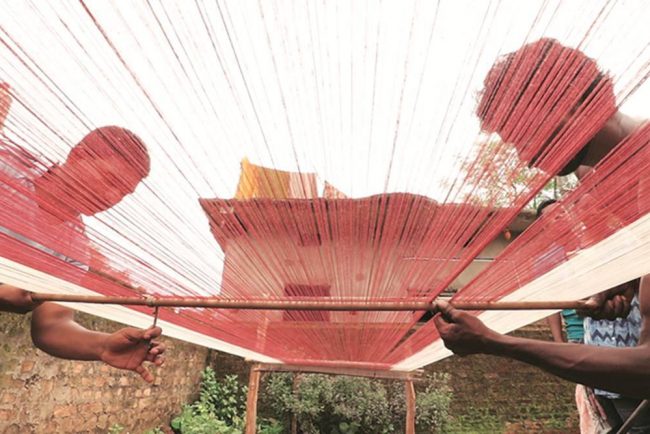
The 200 years old conventional weaving of Odisha is used in the making of the gorgeous Berhampuri Paata sari. The temple design is conspicuous and the zari border is eye-catching. Worn at weddings and auspicious occasions, this sari has the distinction of being draped by Lord Jagannath, Lord Balabhadra and Devi Subhadra in the Puri Jagannath temple. The uniqueness of this sari is that it comes with a ‘joda’ for men.
Woven with pure tassar silk yarns on wooden looms, the Khandua Paata sari dates back to the twelfth century. This sari is usually worn by the women during wedding. The Kahndua has the illustrations of the Gita Govind and is offered to Lord Jagannath.
The Habaspuri sari is a tribal product from Odisha. Basically a cotton sari, the weavers painstakingly make the kumbha along with the traditional patterns of fish and the flowers. The weavers are trying hard to restore this dying art of weaving.
Besides the mentioned varieties are the Saktapar sari, Kotpad sari, Dongris sari with their unique features and carrying an essence of the tradition and culture of Odisha. The woman draped in any of these sarees will definitely be a brand ambassador of the rich tradition and ethnicity of Odisha.
Photo: https://indianexpress.com/
The rice-based traditional foods of Odisha include Pakhala Bhata and Pilaf. The rice is sautéed in oil until the colour changes to golden-brown to prepare the pilaf and mixed with various spices, vegetables, dry fruits. Written by Pradipta Banerjee, Assistant Professor, MSSSoA The cuisine of […]
Non-Fiction Travel and FoodThe rice-based traditional foods of Odisha include Pakhala Bhata and Pilaf. The rice is sautéed in oil until the colour changes to golden-brown to prepare the pilaf and mixed with various spices, vegetables, dry fruits.
Written by Pradipta Banerjee, Assistant Professor, MSSSoA
The cuisine of Odisha has got a flavor of both North and South India, though it is unique in its way. Rice is considered the staple food in the state of Odisha. Yoghurt and chhena (cheese) are common in meals. The rice-based traditional foods of Odisha include Pakhala Bhata and Pilaf. The rice is sautéed in oil until the colour changes to golden-brown to prepare the pilaf and mixed with various spices, vegetables, dry fruits. Sometimes small pieces of meat are added to the rice to make it tastier. Pakhala Bhata is usually made from soaking cooked rice in sour curd and water, and served with fried fish, potatoes, badi choora, and papad on the side. This is a common form of lunch in Odisha. Dalma is another traditional food of Odisha where lentil is mixed with vegetables and spices and served with a variety of dishes like Pitha (a form of pancake), Vada. Dalma is highly proteinaceous and a regular dish in Odia meals. Santula (blend of boiled or fried vegetables like papaya, potato, brinjal, tomato, etc.), Kadali Manja Rai (banana stem curry with cumin, cinnamon, coriander, red chillies), Besara (potato, banana, papaya, pumpkin) and Chaatu Rai or Chaatu Besara (mushroom, tomato, turmeric powder, etc.) are well-known vegetarian dishes while Malai Chungdi (prawn) and Macha Ghanta (fish curry) are famous non-veg dishes that one should try in Odisha. Gupchup, Dahi vada Aloo-dum, Mudi mansa (puffed rice and meat) are delicacies people of Odisha would love to have in snacks. Talking about traditional foods without mentioning the sweet dishes will be a sin, especially if we are talking about Odisha. A long list of mouth-watering sweets are found in Odisha. Chhena Jhili, Khaja, Gaja, Palua Ladu, Odisha Rasogolla, Chaula Bara, Chakuli Pitha, Pora Pitha, Enduri Pitha, Kakara Pith, Chhena Poda, Rasabali – are famous traditional sweets found only in Odisha. If someone wants to try all the traditional foods (vegetarian) and sweet dishes in one go, the best place is to visit Jagannatha temple of Puri, where every day at least 56 items are offered to Lord Jagannatha and distributed among the devotees as Mahaprasad.
Photo: https://mycitylinks.in/
Of the estimated 2,50,000 species of flowering plants at global level, about 3,000 are regarded as food source in which only 200 species have been domesticated. Located in the drier north eastern ghat region of India, the state of Odisha boasts around 2,800 species of […]
Agriculture Non-FictionOf the estimated 2,50,000 species of flowering plants at global level, about 3,000 are regarded as food source in which only 200 species have been domesticated. Located in the drier north eastern ghat region of India, the state of Odisha boasts around 2,800 species of herbs, shrubs, climbers and trees.
Written by Subhrajyoti Chatterjee, Assistant Professor, MSSSoA, CUTM
Nutrition has captured the international spotlight in an unprecedented way as persistent global hunger and under nutrition has underscored the need for urgent action. One in eight people around the world still suffer from hunger and more than double that number are victims of hidden hunger. Of the estimated 2,50,000 species of flowering plants at global level, about 3,000 are regarded as food source in which only 200 species have been domesticated. Located in the drier north eastern ghat region of India, the state of Odisha boasts around 2,800 species of herbs, shrubs, climbers and trees. A number of wild plants which are generally lesser known to a large mass (so that termed as ‘orphan’), used by rural and tribal populations and contributing significantly to their livelihood and food security have escaped recognition and scientific inquiry. Their distribution, conservation, mode of harvest by locals and optimal use require region-specific assessment in order to integrate them into developmental interventions. ‘Orphan’ fruits can be defined as the category of fruit crops which are neither grown commercially on large scale nor traded widely. These are also known as ‘underexploited’, ‘abandoned’, ‘neglected’, ‘underused’, ‘local’, ‘traditional’, ‘forgotten’, ‘alternative’, ‘promising’, ‘underdeveloped’, ‘marginal’ or ‘lesser known’ fruits. Some wild plants and edible fruits are important constituents of biodiversity and their exploitation has become a valuable livelihood strategy and fall back option for rural households during periods of nutritional stress. Historically, tribal and rural people identified and collected plants for food and medicine from forests and developed a range of processing methods in accordance with their needs. With modernization and settled agriculture, this knowledge is becoming lost, a trend that may lead to decreased diversity of indigenous diets and poorer nutrition. In Odisha, it is found that majority of the edible ‘orphan’ fruit species belong to the family Moraceae (10.7 %) and Rhamnaceae (8.9 %). Among the genera, Zizyphus and Ficus were the most highly represented with five species each followed by Grewia with four species. Trees and shrubs made up the highest proportion of edible wild fruit species- 70 % tree, 19 % shrub and 11 % climbers. The majority of species (94.6 %) have only edible fruits, while both flower and fruits of Mahua (Madhuca indica) and Bhadabhadalia (Parrot olax) and leaves and fruits of Bael (Bael/ Stone apple), Kundui/ Marmuri (Sour currant shrub), Bahubara (Indian cherry), Nakkuvalli (Panicled erycibe) are eaten by locals. The principal multipurpose species of the region are: Bael, wild lemons, Bahubara, Kaith/ Katbel (Wood apple), Amla (Indian gooseberry), Bhollataki/ Bonebhalia (Indian marking nut tree), Ambaada (Indian hog plum), Lakoocha (Monkey jack). Use of many species is localized and restricted to casual encounters like Tippani/ Eravalu (Toothe leaf allophylus), Kurpa, Jamun, Suran (Ber), Latkan (Eastern uvaria), whereas species such as as Amla, Bael, Lakoocha, Charu (Chironji/ Cuddapah almond), Kend/ Kendu (Black ebony), Kaith, Khorjurri (Date palm) and Jamun (Java plum) are frequently found and consumed all over the region and beyond. A number of species such as Bael, Dikemali/ Bikke (Gummy gardenia), Gajphala (Indian Laurel), Amla and Bhollataki are widely used in traditional herbal medicine in rural areas of the state. Some fruits are eaten raw, either ripe or unripe, while others are cooked and consumed as curries (e.g. Dimri/ tender figs of Ficus hispida, F. racemosa and F. semicordata) or are pickled or made into ‘curry paste’ or ‘chutney’. Bhadabhadalia, Dimri (Fig), Potua (Divine jasmine), Aradanda (Indian caper) and Goble (Hairy fig) are used as vegetables. Seeds of Kangara (Burma ironwood) and Siyali (Bauhinia climber) are roasted and eaten by the Kohla and Juang tribes. Dried seeds of Charu, Bonebhalia and Mahua are eaten directly or in semi-processed form by tribals. Santals and Juangs consume the tender and immature seeds of Kendu (Black ebony) and Gaab (Indian persimmon) as famine foods. Insipid fruits of Osta (Peepal) and Baragachha (Banyan tree) are also considered to be distress foods and are eaten in times of food scarcity. Ripe fruits of Bael, Lakoocha, Bilangada (Governor’s plum), Roxburgh’s cherry, Karamdika (Wild Karonda), Latkan, Panicled Erycibe, Kendu and Khorjurri are used in most localities as they have a sweet taste and pleasant flavour. Kantei koli (Indian jujube), Lakoocha, Kundui and Amla are eaten raw or sun dried and preserved in mustard oil after mixing with salt.
The tropical and subtropical tracts of India are bestowed with wide range of diversity in several fruits, which are growing wild/semi-wild, are unattended and underutilized. Most of these species have a wide adaptability as well as high degree of tolerance and hence can thrive well under most adverse situations. In spite of rich germplasm existing in India, for most of the underutilized fruits, no standard variety has been developed so far. Many of these fruits are nutritionally very rich which can play a vital role in nutritional security of Indian people and are of great medicinal value. These fruits hold promise for sustainable agriculture, particularly for small farmers by augmenting their income with the least risk. Our urgent task is to develop/select suitable variety/genotype and to standardize production protocol and to popularize these fruits.
Introduction: Nikola Tesla, the enigmatic inventor and engineer, is renowned for his revolutionary contributions to science and technology. His groundbreaking innovations in alternating current (AC) electricity, wireless communication, and various other fields have left an indelible mark on modern civilization. However, alongside his numerous achievements, […]
Science FictionIntroduction:
Nikola Tesla, the enigmatic inventor and engineer, is renowned for his revolutionary contributions to science and technology. His groundbreaking innovations in alternating current (AC) electricity, wireless communication, and various other fields have left an indelible mark on modern civilization. However, alongside his numerous achievements, Tesla’s life and work have also become fertile ground for various conspiracy theories. In this article, we will delve into some of the most popular conspiracy theories surrounding Nikola Tesla, referencing notable researchers and scientists.
“The Anti-Gravity Handbook” Influence:
One prominent conspiracy theory that has gained traction suggests that Tesla discovered anti-gravity technology. This theory was notably popularized in a book titled “The Anti-Gravity Handbook” by D. Hatcher Childress. According to Childress, Tesla’s experiments revealed hidden anti-gravity principles that powerful organizations subsequently suppressed to maintain control over energy and transportation industries. However, this theory lacks substantial evidence and is considered by many scientists to be a baseless claim that undermines Tesla’s legitimate scientific legacy.
The Hidden Free Energy Device:
Another widely circulated conspiracy theory revolves around the concept of a hidden free energy device invented by Nikola Tesla. According to this theory, Tesla found a way to harness unlimited energy from the Earth’s natural resources without relying on fossil fuels or conventional power sources. Advocates of this theory argue that Tesla’s discoveries posed a threat to powerful energy corporations, leading to the suppression and concealment of his work. Nevertheless, mainstream scientists contend that the laws of thermodynamics make the idea of a perpetual motion machine or free energy device impossible, and there is no credible evidence to support such claims.
Tesla’s Interactions with Extraterrestrials:
Some conspiracy theories take a more imaginative turn, suggesting that Tesla had contact with extraterrestrial beings who provided him with advanced knowledge and technology. These theories often cite Tesla’s enigmatic statements about receiving information from “space intelligences.” While Tesla was indeed known for his eccentricities and visionary ideas, there is no concrete evidence to support the notion of extraterrestrial interactions. Such theories are primarily based on hearsay and unverified anecdotes, making them speculative at best.
The “Death Ray” and Government Suppression:
One of the most enduring conspiracy theories surrounding Tesla revolves around the alleged invention of a powerful “death ray” or directed energy weapon. According to certain accounts, Tesla’s experiments with high-frequency oscillations resulted in a potent weapon capable of emitting destructive beams. The conspiracy theory goes on to suggest that the United States government seized Tesla’s research after his death to prevent the weapon from falling into the wrong hands. However, while Tesla did work on directed energy concepts, there is no credible evidence to support the existence of a functional “death ray” or any government suppression of such technology.
The Tunguska Event and Tesla’s Alleged Involvement:
Another popular conspiracy theory links Tesla to the Tunguska event of 1908—an enormous explosion that flattened over 770 square miles of Siberian Forest. Some theorists claim that Tesla’s wireless transmission experiments caused the explosion, which he subsequently covered up to avoid scrutiny. However, historical records and scientific analysis overwhelmingly point to a meteoroid or comet as the most likely cause of the Tunguska event, debunking any connection to Tesla’s work.
Conclusion:
While Nikola Tesla’s contributions to science and technology remain unparalleled, his legacy has become shrouded in various conspiracy theories. As we explore these theories, it is essential to approach them critically and distinguish between verifiable historical facts and speculative claims. Nikola Tesla’s brilliance and achievements continue to inspire and influence generations of scientists and innovators, and it is crucial to remember him for his genuine scientific legacy rather than unsubstantiated conspiracy theories.
The house had been abandoned for years, and its dark secrets remained hidden from the prying eyes of the curious. Among the forgotten treasures left behind was a collection of antique dolls—beautifully crafted, with eyes that seemed to follow you wherever you went. Written by […]
FictionThe house had been abandoned for years, and its dark secrets remained hidden from the prying eyes of the curious. Among the forgotten treasures left behind was a collection of antique dolls—beautifully crafted, with eyes that seemed to follow you wherever you went.
Written by Sai Ansuman Padhy, B.Tech (Ag).
Once upon a time, in a small village tucked away in the heart of India, there stood an old, dilapidated house. It was said to be haunted, and the villagers whispered stories of eerie occurrences and unexplainable phenomena that took place within its decaying walls. Legends spoke of a restless spirit that dwelled within the house, trapped in the mortal realm and seeking solace.
The house had been abandoned for years, and its dark secrets remained hidden from the prying eyes of the curious. Among the forgotten treasures left behind was a collection of antique dolls—beautifully crafted, with eyes that seemed to follow you wherever you went. The dolls were said to be imbued with a mysterious energy, their porcelain bodies holding the essence of the lost souls that inhabited the house.
One stormy night, a young girl named Meera and her family sought refuge from the pouring rain in the haunted house. Unaware of the tales that circulated about the place, they thought it would provide temporary shelter until the weather cleared. The family huddled together in the dimly lit living room, surrounded by dusty furniture and the eerie gaze of the dolls.
As the night wore on, strange things began to happen. Soft whispers echoed through the house, and the dolls seemed to move of their own accord. Their delicate hands reached out as if longing for human contact, while their eyes glimmered with a mixture of sadness and desperation. Meera couldn’t tear her gaze away from them, a strange sense of connection forming between her and the ghostly figures.
Intrigued, Meera decided to investigate further. Guided by an unseen force, she followed a trail of flickering candlelight up the creaking staircase, her family pleading for her to stay behind. The second floor was shrouded in darkness, and Meera’s heart raced as she ventured deeper into the unknown.
In a forgotten room at the end of a long corridor, Meera discovered an old chest. Inside, she found a weathered diary that belonged to the previous owner of the house—a woman named Kalyani. The diary revealed a tragic tale of lost love, betrayal, and a broken heart that refused to find peace even in death.
Kalyani’s spirit had been trapped within the dolls, her unfinished business binding her to the mortal realm. Meera’s empathy touched the ghostly woman’s heart, and she longed for someone to release her from her eternal torment. The dolls, once cherished possessions, now held the key to setting Kalyani’s spirit free.
With newfound determination, Meera returned to her family and shared the story she had discovered. Together, they devised a plan to help Kalyani find closure. They gathered all the dolls and placed them in the center of the living room, forming a circle around them. Holding hands, they recited ancient chants and prayers, calling upon the spirits to grant Kalyani peace.
As the incantations filled the air, a soft, warm light enveloped the room. One by one, the dolls’ porcelain bodies began to crack and crumble, their ghostly energy released. Finally, the last doll shattered, and Kalyani’s spirit emerged, bathed in a gentle glow.
With tears streaming down her ethereal face, Kalyani mouthed a silent thank you before her spirit dissolved into the air, disappearing into the night. The haunted house grew silent, and a sense of tranquility settled upon the village, as if a heavy burden had been lifted.
From that day forward, the house stood as a testament to the power of compassion and understanding. The dolls, once vessels of restless spirits, remained silent and motionless, no longer haunted by the ghosts of the past. Meera and her family were forever changed by their encounter
Odisha’s incredible wildlife wealth needs to be preserved for the future so that our children shall be true inheritors of this state’s natural heritage. We should keep a careful and close watch on the state of our wildlife sanctuaries to ensure that its wildlife is […]
Nature Non-FictionOdisha’s incredible wildlife wealth needs to be preserved for the future so that our children shall be true inheritors of this state’s natural heritage. We should keep a careful and close watch on the state of our wildlife sanctuaries to ensure that its wildlife is safe and well protected
Written by Siba Prasad Parida, Assistant Professor, Department of Zoology
Our State Odisha is a paradise for wildlife. The Olive Ridley sea turtles arrive every year to breed on the Odisha coast have put the state on the international wildlife map. Turtle lovers throughout the world eagerly await this wonderful natural event when thousands of turtles congregate in the Odisha coast from October onwards. The best-known site is Gahirmatha Marine Sanctuary. Devi river mouth and Rushikulya river mouth are the two other spots where mass nesting takes place. The Olive Ridley sea turtles mass nesting is one of nature’s rare events which is Odisha’s unique natural heritage and we all are proud that nature has bestowed this privilege on us. However, let us not forget that the state is also home to many other species of wildlife thanks to the wide diversity of natural habitats which the state possesses. To protect this invaluable wildlife wealth, the state government has declared several Protected Areas (Wildlife Sanctuaries and National Parks).
The world famous Bhitarkanika mangroves forests are home to some of the world’s largest crocodiles. The salt water crocodiles are found here in large numbers. Beware of the salties! During nesting they can be quite nasty. The cold season is the best time to sight them. Take a country boat and enter the narrow creeks of Bhitarkanika and find these lovable giants lounging on the mud banks basking in the winter sun.
Chilika lagoon is Asia’s largest brackish water lagoon with a water spread of approximately 900 sq. kms. Bird watching is an unforgettable experience which no one should miss. Just hire a boat and sail to Nalabana, Mangalajodi the bird paradise which will transport you to another world. The only sound reflected over the tranquil waters of the lagoon is the joyful twitter of waterfowl as they bask in the pale morning sun. Chilika hosts nearly a million migratory waterfowl every year. They belong to nearly 225 species. However, the lake is also world famous for another rare creature, the Irrawady dolphins. Irrawady dolphins are small dolphins which are found in river mouth and near shore sea waters. These dolphins stay in small family groups and love to gambol in the lake waters. They are quite friendly and sometimes come close to the boats. It is a wonderful sight to see the watchful mother closely guarding her calf and teaching her how to catch the lake fish.
As travel inland in the forested hills and valleys, one must encounter a wide variety of forest animals like elephants, tigers, leopards, sambhar, deer,etc.
The river Mahanadi courses through the deep Satkosia Gorge. Never miss a boat ride in the Mahanadi. It is a mind-boggling experience floating down this 22 kms stretch of Mahandi from Binka to Kamaladiha. The steep hill slopes dip into the river on both sides and you are shadowed by the high hills as you sail down the tranquil waters of Mahandi. Both species of crocodiles i.e., the gharial and the mugger are sighted here. One can also sight river turtles basking on the rocks on the banks of the river.
Simlipal is a water rich area and will be amazed by the huge number of streams which flow perennially in this area. There are wonderful waterfalls at Joranda and Barheipani. Simlipal is a treasure house of orchids and more than 90 varieties have been listed here. Elephants are in abundance in this park. Herds of chital and sambhar grazing in the meadows when drive through the Park. The place is also a paradise for bird watchers since you find many forest species like crested tree swift, red spur fowl, black shouldered kite, crested serpent eagle, brown fish owl, hill myna. In fact, the place is famous for hill myna and once upon a time, the forest department used to run a thriving business, catching the chicks from the tall sal trees and rearing them at Jashipur. They used to be exported in large numbers to foreign countries where a huge demand existed since the hill myna is a talking bird and can closely mimic human voice.
Odisha’s incredible wildlife wealth needs to be preserved for the future so that our children shall be true inheritors of this state’s natural heritage. We should keep a careful and close watch on the state of our wildlife sanctuaries to ensure that its wildlife is safe and well protected.
Photo Credit: https://alternativetoursindia.com/